A number of factors contribute to increasing the Hirsch index, including regular publications in Scopus or Web of Science, co-authoring articles, participating in scientific conferences, and optimizing author profiles in databases. However, there is another aspect that should not be underestimated – affiliation. What is it? Why is it needed? How does it affect a researcher’s Hirsch index? Read on to find out.
What is Affiliation?
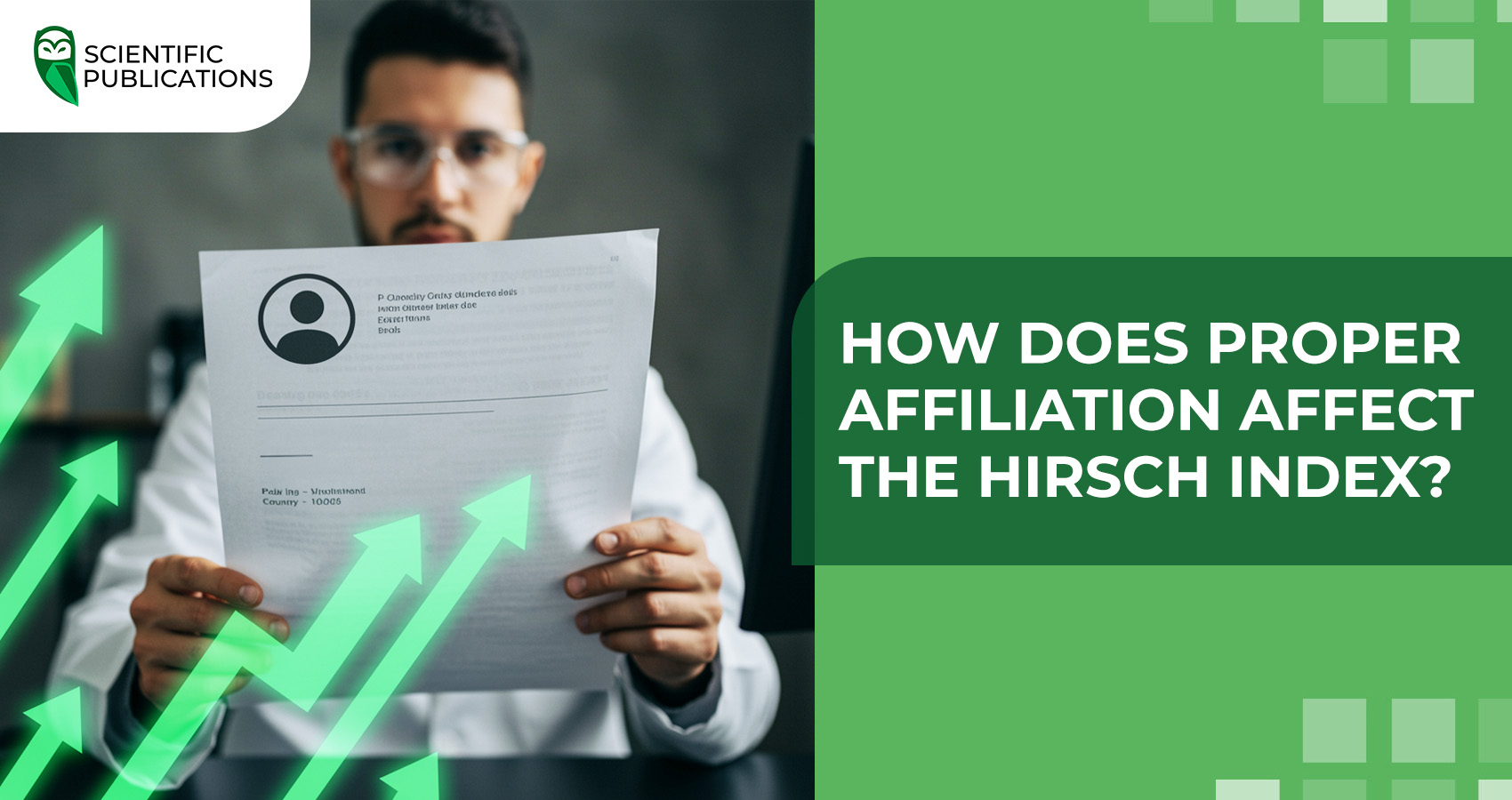
Affiliation – refers to the organization with which an author of a scientific publication is associated. It typically includes the name of the institution (university, research institute, laboratory), its address, and, in some cases, a specific department or unit.
Affiliation is indicated in an article to specify where the research was conducted and to link the author to a particular scientific organization or university.
A correct affiliation is crucial not only for identifying the author but also for accurately tracking publications and their citations in databases such as Scopus, Web of Science, or Google Scholar.
The Hirsch index and affiliation: what’s the connection?
At first glance, it may seem that affiliation does not affect the Hirsch index. However, this is a misconception. The proper indication of affiliation directly impacts whether a published article is correctly linked to the author’s profile in databases.
This, in turn, contributes to the growth of a researcher’s h-index. How?
1. Accurate Citation Tracking
When affiliation is correctly specified, Scopus or Web of Science accurately identifies the author and links all their publications. This ensures that every citation of an article is credited to the researcher’s profile, contributing to the growth of their h-index.
2. Avoiding duplicate profiles
Incorrect or inconsistent affiliation can lead to the creation of multiple author profiles in databases.
For example, if an author uses different variations of their affiliation (e.g., different names for the same institution or errors in spelling), databases may create multiple profiles for the same person, resulting in lost citations.
3. Increasing publication visibility
A correct affiliation links an article to a prestigious institution, which can enhance the publication’s credibility. Articles authored by researchers from well-known universities or organizations are more likely to attract attention from other scholars, increasing the likelihood of citations and, consequently, the researcher’s h-index.
4. Meeting Journal Requirements
Many journals have strict requirements for affiliation formatting. Errors or incomplete information can lead to improper indexing of a publication, making it harder to find and cite. For instance, omitting an institution’s address or using an outdated affiliation may result in lost citations.
How to correctly specify affiliation?
Having understood how affiliation impacts an author’s Hirsch index, the next step is to learn how to format this information to ensure it is correctly displayed in scientific databases and enhances the visibility of your publications.
To properly indicate affiliation, follow these guidelines:
- use the official name of the institution: Verify how your organization is officially listed in international databases or official documents;
- maintain consistency: Use the same affiliation format across all publications;
- include the full address: Provide the city, country, and, if required, postal code to help databases uniquely identify the organization;
- add ORCID or ResearcherID: A unique author identifier (e.g., ORCID or ResearcherID used in Web of Science) helps link all your publications, even if your affiliation changes;
- check database records: Regularly update your profile in Scopus, Web of Science, or Google Scholar, merging duplicate entries and correcting affiliation errors.
Affiliation is not just a formality, but a critical element that ensures accurate tracking of publications and citations in scientific databases. By following these recommendations, you can correctly format all necessary information and avoid errors or inaccuracies.
If you’re facing challenges with publishing in Scopus or Web of Science, contact Scientific Publications. Our experts will provide a free consultation, assist in selecting a suitable journal, and guide you through every step of the process. To learn more about our services, fill out the form below, and our manager will contact you shortly. Together to the new scientific achievements!