


Co-authorship has become a fairly common form of co-operation due to its efficiency. However, as in any other field, the key to the success of collaborative work is the proper allocation of responsibilities between all participants. In this article, we will look at the main roles that scientists can take on in collaborative research and provide recommendations on how to optimise co-authorship.

Scientific co-authorship: which roles exist?
It is worth starting with the fact that a research team working on a project has a certain structure. It may vary depending on the number of participants and the complexity of the project. However, there are usually a few key roles. In the following we will look at each of these separately.
First author
The first author is the scientist whose contribution is most important to the research. This, in turn, is the reason why his name is listed first when citing a scientific paper.
In other words, the first author can be called the leader of the research group. This is manifested not only in the status but also in the number of responsibilities, which include:
- active participation in the preparation and correction of the text of the article;
- participation in the planning and development of the general concept of the study;
- gathering information, conducting experiments and surveys, analysing scientific sources;
- interpreting research results with the help of tables, diagrams and other visual materials;
- key intellectual contributions, shaping the main content of the paper.
Corresponding author
The second most important member of the research team is the corresponding author. He or she deals with organisational matters that cover both the publication process and the post-publication process.
The responsibilities of a scholar who fulfils this role can be divided into two types: pre-publication and post-publication.
|
Before publication |
After publication |
|
|
Co-authors
Also key roles include co-authors - researchers who make a significant contribution to the research study at all its stages. They are actively involved in conceptualising the work, collecting and analysing data, and preparing publications. In addition, co-authors provide valuable comments and suggestions at the peer review stage, contributing to the improvement of the work.
It is also their responsibility to select a suitable journal for publication and to coordinate all versions of the manuscript. Co-authors jointly determine how best to present the research findings and share responsibility for the credibility and quality of the research paper.
Assistants
This position is not always present, but that does not minimise its importance. Assistants are early career researchers who, despite limited experience in scientific publishing, make a tangible contribution to the work of the project. Their main function is to support key members of the research team.
In practice, assistants' responsibilities can range from technical to analytical tasks. They often assist in data collection and pre-processing, participate in the conduct of experiments, compiling tables, graphs, preparing the reference list, and may also assist in the preparation of specific sections of the manuscript.
Although the participation of assistants does not always imply authorship of the paper, their help is often acknowledged in the acknowledgements section. However, if the amount of work done by them is substantial and affects the content of the research, they may well be included as co-authors.
How to correctly formalise the authorship of scientists?
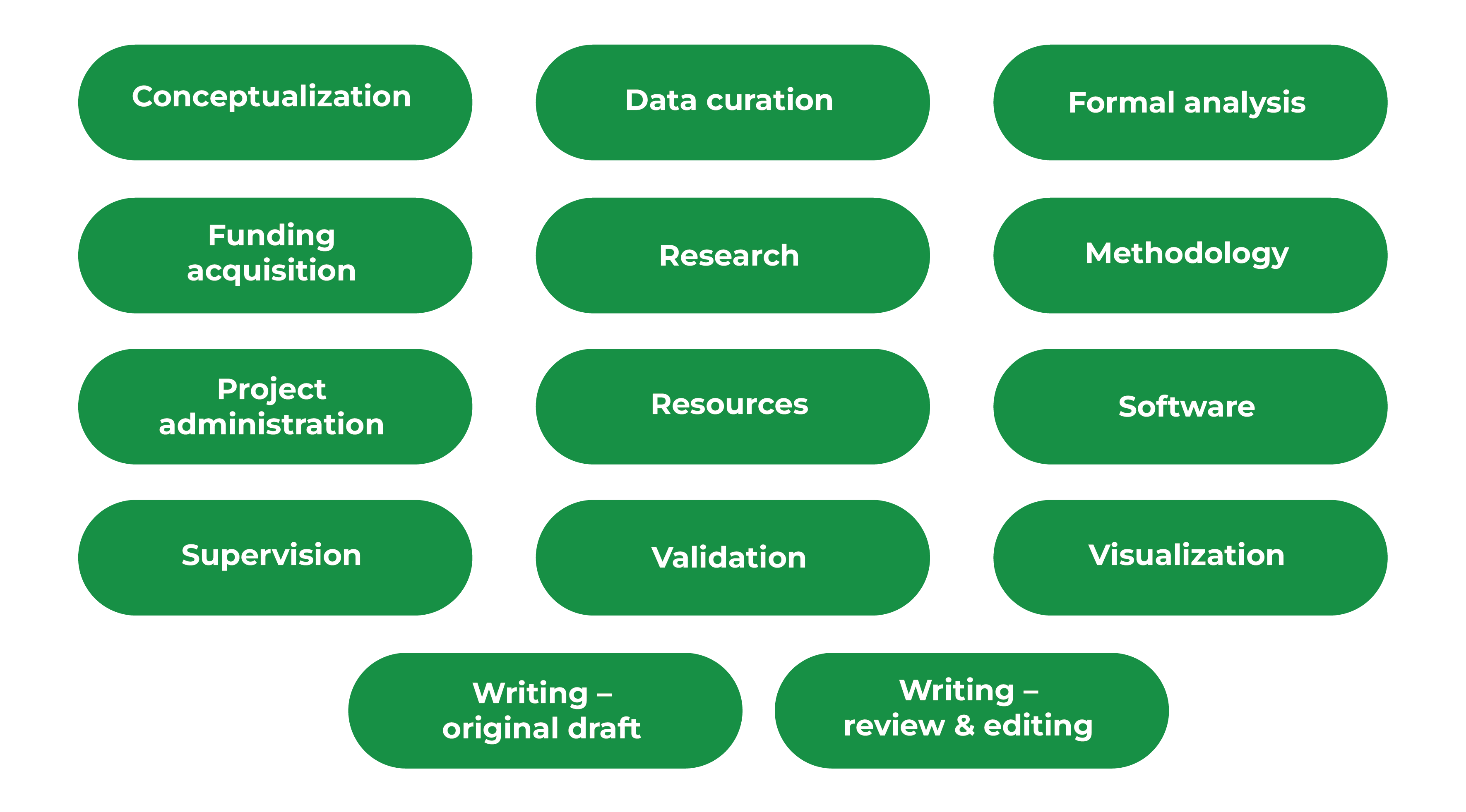
This question is asked by many researchers without significant experience in co-authorship. It is worth noting that the authorship of a publication depends on the requirements of the journal in which scientists plan to place the article. However, a common standard in the scientific community is the role taxonomy developed by the CRediT platform.
This list makes it much easier for scientists to complete the application when publishing with co-authors.
How to optimise co-authored work?
- Clearly assign roles. Identify who is responsible for what from the outset to avoid duplication or gaps in the work.
- Communicate regularly. Hold periodic meetings or use platforms to discuss progress so everyone is aware of the current status of the project.
- Uniform design standards. Agree on document format, writing style and publication templates to simplify the writing process.
- Use collaborative tools. Use platforms (e.g., Google Docs, Overleaf, Trello) for collaborative editing, task tracking, and file sharing.
- Be open to feedback. Encourage constructive criticism and discuss comments in a timely manner to improve the quality of work.
- Agree on deadlines and goals. Set realistic deadlines and common goals to keep the team motivated and disciplined.
- Document participants' contributions. Keep records of each co-author's contribution for transparency and to avoid publication conflicts.
Although co-authored work is quite effective for scientific research, it is essential that it is properly organised. A transparent and clear approach to role assignment will help you avoid possible conflicts during the publication phase.
If you are looking for qualified assistance with co-authored publication, contact "Scientific Publications". We will provide you with support at all stages of the work: from the selection of a journal and communication with its editorial board, to the direct publication of the article. To get a free consultation, fill out the form below and our manager will contact you as soon as possible. Together to new scientific achievements!


