Publication in journals included in the Scopus and Web of Science databases is considered an important indicator of the quality of scientific work. These databases impose strict requirements on journals in order to index only reliable and authoritative publications. How does this process work? In this article, we will look at the criteria that Scopus and Web of Science use to select journals for inclusion in these databases.
Criteria for selecting journals in Scopus
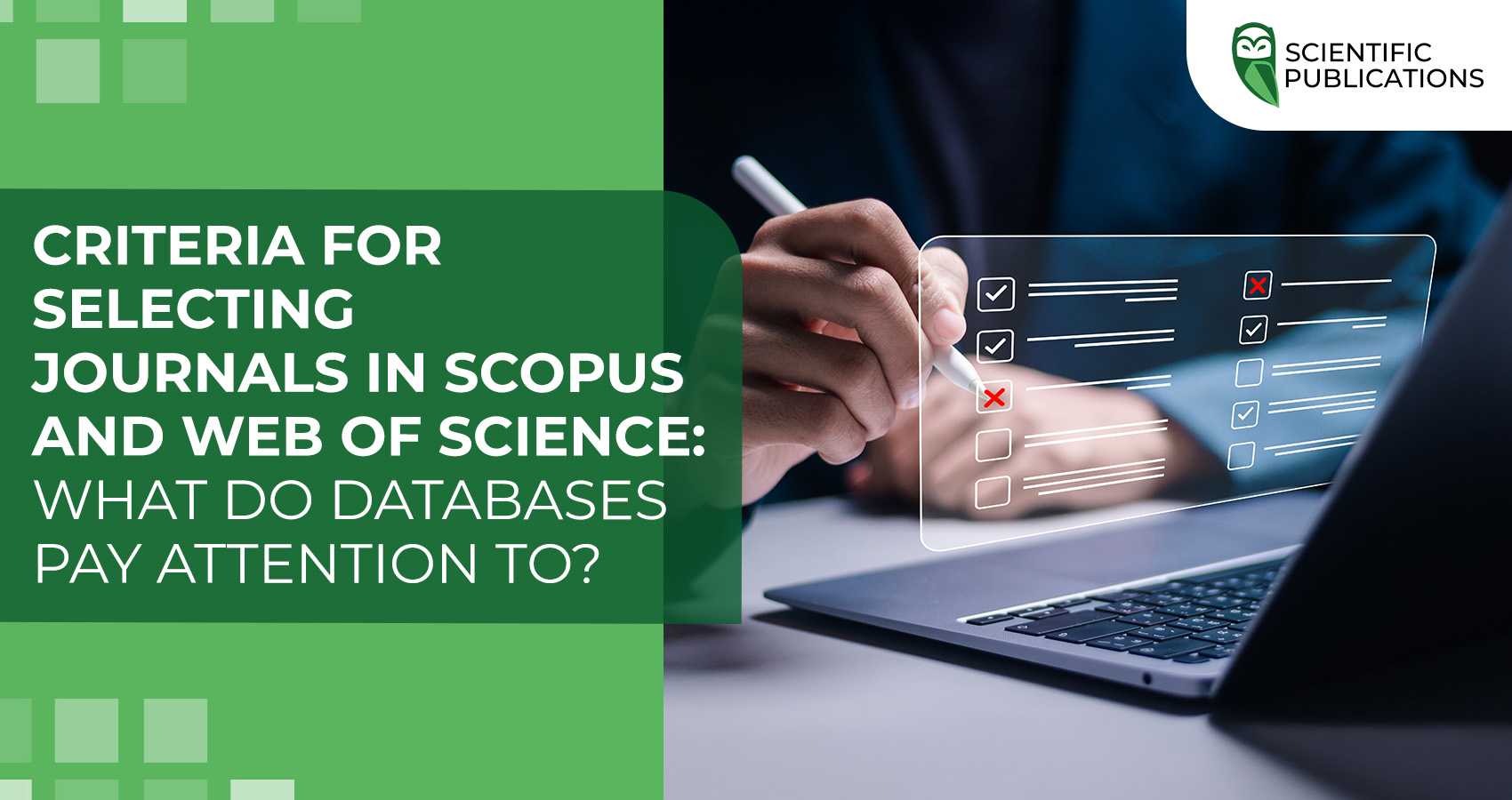
In order for a scientific journal to be indexed in Scopus, it must undergo an editorial review. There are five categories according to which its characteristics are analysed. Below, we will examine each of them in more detail.
1. Journal policy
The journal must have a clear and convincing editorial policy, including a transparent review process (e.g., double-blind or open review). To learn more about the types of peer review of scientific articles, read our article on this topic.
It is also important to have diversity in the geographical distribution of editors and authors. In this way, the journal demonstrates its international reach.
2. Content
Another key criterion is content. The journal's articles should make a significant academic contribution to their field of science. As for abstracts, they should be clear, informative, and reflect the essence of the research.
In addition, for a publication to be indexed, the articles it publishes must correspond to its stated goals and thematic focus.
3. Reputation of the journal
An important characteristic is the citation rate of the journal's articles, which reflects its influence in the scientific community. In addition, the database takes into account the authority of the editor-in-chief and members of the editorial board. This aspect helps to assess the level of competence of the people who work for the journal.
4. Regularity of publications
Another important aspect that is taken into account when evaluating a journal is the frequency of its publication. It is extremely important that the journal is published strictly according to the specified schedule, without delays or interruptions. This, in turn, confirms its stability and reliability.
5. Online access
It is worth noting that if a journal claims to be indexed in Scopus, online access will be an advantage for it. This means that the full content of the scientific publication must be available on an internet platform.
In addition, the journal's home page must be in English and provide all the necessary relevant information for authors (the journal's subject area, the disciplines it covers, and the review process).
Criteria for selecting journals in Web of Science
The mechanism for selecting journals in Web of Science is slightly different from that used by Scopus. The database has a more structured approach, dividing the process into four stages, at each of which the journal is evaluated according to specific criteria (24 in total). Below are the main stages and their key aspects.
1. Initial sorting
At this stage, the basic characteristics of the journal are checked: the presence of an international standard serial number (ISSN), the name of the journal, information about the publisher, URL, access to content, the presence of a clear review policy and contact information.
2. Editorial sorting
This involves evaluating the content of the journal, including the presence of article titles and abstracts in English, the use of bibliographic information in Latin script, clarity of language, and style of presentation.
The functionality of the website, adherence to scientific ethics standards, and information about editorial and author affiliation are also checked.
3. Journal quality assessment
At this stage, the composition of the editorial board, the reliability of the journal's statements about its activities, the quality of peer review, and the relevance of the content are analysed.
Particular attention is paid to the availability of information about grant support, compliance with international standards of the scientific community, distribution among authors, and the quality of references to literature.
4. Assessment of scientific influence
The final stage includes a comparative analysis of citations of the journal, its authors and editorial board. The significance of the content is assessed in terms of its influence on the scientific community and its relevance to the field of research.
As you can see, both databases take a thorough approach to evaluating scientific journals. Due to the criteria mentioned above, Scopus and Web of Science ensure the high quality of scientific publications and directly contribute to the development of various fields of science.
If you want to publish your article in Scopus and Web of Science, Scientific Publications is ready to help you. Our specialists will develop a personalised publication plan for you and provide support from the selection of a journal and submission of an article to its indexing. To receive a free consultation, fill out the form below, and our manager will contact you shortly. Together towards new scientific achievements!